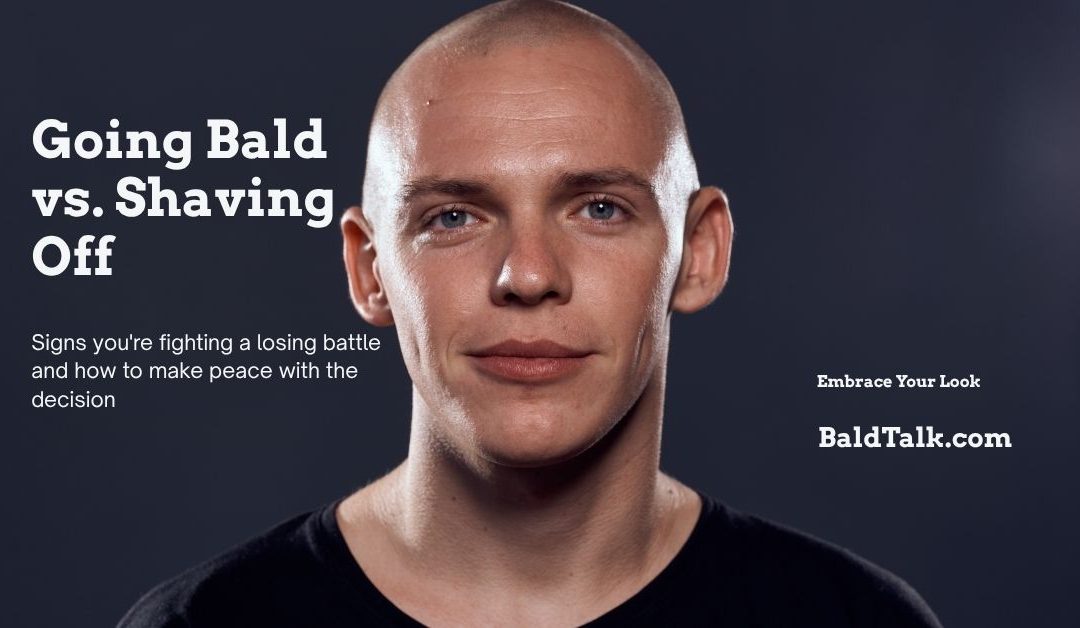
Signs you're fighting a losing battle and how to make peace with the decision.
You know the moment. Overhead light catches your scalp at the wrong angle after a shower, and what used to look like a little thin up top has crossed into something else. Maybe you've been doing the same morning routine for a couple of years now, nudging hair this way or that, trying the product your barber swore by, telling yourself you can stretch another six months before anyone really notices.
I did all of that. Then one Saturday, I pulled the clippers down, ran them across my scalp, walked into Monday looking like a different person, and realized the sky had not fallen. I wish someone had told me two years earlier exactly what I'm going to tell you now.
Every balding guy eventually has to answer the same question: keep fighting, or shave it off. Most of us spend far too long in the middle ground, which happens to be the worst place to be. Here's how to tell when you've crossed the line from managing it into fighting a losing battle, and how to make peace with the decision once you do.
The Numbers Nobody Wants to Hear
Male pattern baldness is not rare. Androgenetic alopecia affects roughly 50 to 60 percent of men by age 50, and close to 80 percent by age 70. Put differently, if you live long enough, you're more likely to lose your hair than keep it. That isn't cosmic injustice. It's the default setting for half the human population.
Hair loss follows a predictable trajectory called the Norwood scale, which runs from stage 1 (full coverage) through stage 7 (the horseshoe). Most men who start losing hair in their twenties or thirties will keep progressing unless they intervene, and even when they do, they typically progress more slowly rather than stop entirely. The pattern is fixed. The timeline is not.
Knowing your stage matters because it decides what's actually possible. Early stages respond to treatment. Late stages really don't. The guys I see struggling the most are the ones who have been told, or who tell themselves, that they're still in the early intervention window when the mirror is telling a different story.
The Signs You're Fighting a Losing Battle
Some signs are about your hair. Others are about your behavior. Both matter.
You spend real mental bandwidth on hair management. Not a passing thought in the mirror. I mean, calculating where to sit at a restaurant so the overhead lighting doesn't hit your crown. Avoiding windy days. That small flinch before every profile photo. When you're editing your life around your hairline, your hairline has already won.
Styling has become camouflage. There's a difference between a haircut and a concealment strategy. If your current style exists primarily to hide scalp, if your barber has started asking how you want to work around the crown, if you're routinely reaching for hair fiber powders or spray concealers to fake density, your remaining hair is no longer helping you. It's just stretching the timeline on a decision you already know is coming.
Your scalp is visible in ordinary light. Not bathroom-mirror-at-a-weird-angle light. Ordinary light. When a friend takes a candid photo of you from above or behind, and you flinch at the result, believe the photo. Cameras don't lie the way mirrors do.
You've hit Norwood 5 or further. At this stage, the hair on top of your scalp is thin or gone, and a visible horseshoe is forming around the sides. You can still cut the remaining hair short and have it look intentional. Waiting longer doesn't give you more options. It just gives you a longer denial window.
Treatments have stopped moving the needle. If you've been on finasteride, minoxidil, or both for a full year and the photos tell an honest story of continued loss, the medication isn't failing you in some mysterious way. It simply isn't enough at your particular stage, and nothing else reliably will be.
What the Treatments Can and Can't Do
Let's be clear about what's realistic. Finasteride and minoxidil, the two FDA-approved medications for male pattern baldness, work best when hair loss is early. A recent real-world evaluation of 502 men on combined oral finasteride and minoxidil therapy found that 92.4 percent had stable or improved hair after 12 months. That sounds impressive until you read what stable means carefully. These drugs are genuinely excellent at holding the line. They are mediocre to poor at regrowing hair you've already lost.
Hair transplants are a different animal. A modern FUE or FUT procedure moves your own DHT-resistant follicles from the back of your head to the top, and the transplanted hair is permanent. It's also expensive. National average costs in the U.S. run roughly $4,400 to $12,000, and many men end up needing 2,000 to 3,500 grafts to get a natural-looking result. The bigger limitation, though, is the donor area. You only have so much hair on the back of your head. If your loss is aggressive and you're young, a good surgeon has to plan not just for today but for the bald pattern you'll have at 55. Any ethical transplant doctor will decline to operate on a man whose loss isn't stable yet.
None of this is a reason to avoid treatment if you want to try it. It's a reason to be honest about what treatment can actually deliver. If you've already been on the medications, you've already crossed into advanced Norwood, and you don't want to spend five figures on surgery, the decision tree narrows fast.

The Research on Shaving
Here's the part most guys don't find out until they've already done it: shaving comes with real social upside, and it's been studied.
A University of Pennsylvania study by Albert Mannes at the Wharton School found that men with shaved heads were rated as more dominant, taller, and stronger than the same men with hair. In one experiment, shaved men were perceived as nearly an inch taller and about 13 percent physically stronger than their coiffed counterparts. A third experiment used only written descriptions of men and compared three versions: thick hair, thinning hair, and shaved. The shaved version scored highest on dominance, masculinity, leadership, and confidence. The thinning version scored lowest on almost everything.
One nuance is worth stating plainly. The same research found that shaved men were rated slightly less conventionally attractive and looked a couple of years older than men with thick hair. But if you're already balding, the honest comparison isn't you with a full head of hair versus you shaved. It's you with thinning hair versus you shaved. On that comparison, the shaved version consistently wins.
Look at the professions where shaved heads are most common. Military. Law enforcement. Professional athletes. Special forces. These are signals American culture already reads as competent, confident, and in charge. When you shave, you step into that category by default.
The Emotional Math
The physical signs are easy. The harder part is what's happening between your ears.
Losing hair feels like losing something you didn't realize you'd attached so much of yourself to. That's real. It isn't vanity. Research going back decades documents measurable emotional distress, identity shifts, and reduced quality of life in men experiencing premature hair loss. Anyone who tells you it's just hair, get over it, has probably never watched their hairline retreat in real time.
Here's what I've learned, and what almost every bald guy I've talked to agrees with: the worst part of losing your hair is losing it slowly. The uncertainty. The constant scalp-checking. The feeling that you're already bald somewhere in a future version of yourself, but pretending you aren't. Shaving ends all of that in about ten minutes.
The first time you see yourself fully shaved, you won't recognize the guy in the mirror. That's normal. Most men need two to three weeks to adjust, and a couple of months to stop reflexively reaching for hair that isn't there. After that, the decision starts feeling less like a loss and more like a release.
How to Make Peace with It
A few things helped me.
Stop framing it as giving up. Start framing it as taking ownership. Fighting hair loss with medications, concealer powders, and styling tricks is a reactive posture. Shaving is a decision. The distinction sounds subtle, but it changes how you carry the rest of yourself.
Commit to the full look. If you shave your head, shave it well. Invest in a decent electric head shaver or a dedicated head razor. Moisturize daily. Wear sunscreen on top whenever you're outside. Scalp skin cancer is more common in bald men, and the Skin Cancer Foundation notes that 5 to 10 percent of actinic keratoses (the precancerous scaly patches common on sun-damaged scalps) eventually turn into skin cancer. A broad-spectrum SPF 30 or higher, and a real hat when you're out in the sun for any stretch of time, is not optional once you're exposed up there. Grow a beard if one suits you, or keep your jawline clean and sharp. The whole aesthetic has to work together, or it doesn't work at all.
Stop polling your friends. The single most consistent thing I've heard from other bald men is that the reaction they feared never really came. Friends noticed for a day. Family adjusted over a weekend. Most strangers wouldn't know any other version of you existed. The internal audience you've been performing for is almost entirely in your own head.
The real question isn't whether you should shave. If you're reading this, you probably already know the answer. The question is whether you're going to spend another two years arriving at it, or whether you're going to pick up the clippers this weekend and find out what the other side actually looks like.
The other side, for the record, is better than you think.
© 2026 by BaldTalk.com All rights reserved. No part of this document may be reproduced or transmitted in any form or by any means, electronic, mechanical, photocopying, recording, or otherwise, without prior written permission.